
What Is a Banana Bag IV? Ingredients, Uses, and Limits
The name is memorable, but what is actually in a banana bag? Explore its ingredients, medical uses, and differences from other IV mixtures.
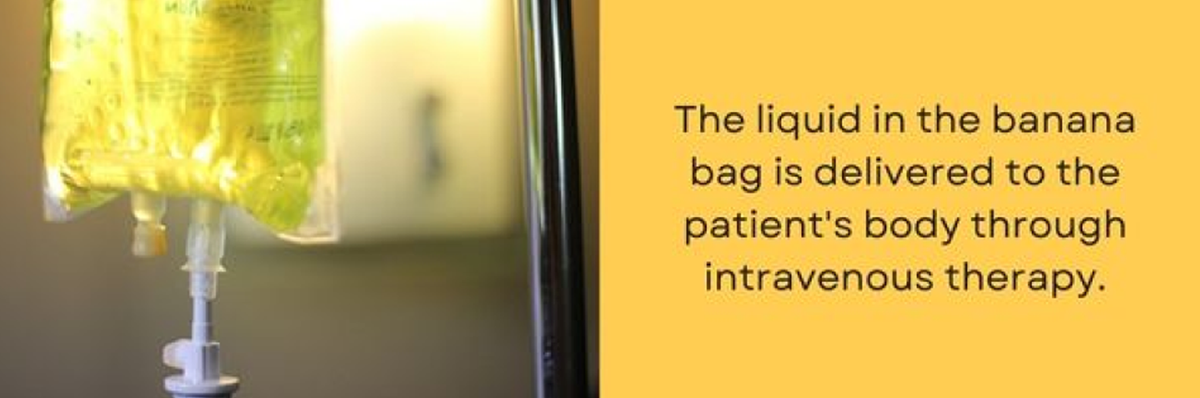
With a name like banana bag, you might expect something fruity. In medical care, though, the term usually refers to a yellow-colored IV mixture containing vitamins and fluid. You may have heard it mentioned in a hospital, in a conversation about nutrition, or on a wellness menu.
Those settings can make it sound like one familiar treatment does many different jobs. In reality, the ingredients and reason for using them matter much more than the nickname.
A banana bag commonly includes thiamine, folate, and other vitamins, sometimes with magnesium. Its yellow appearance often comes from riboflavin, a B vitamin. It does not contain banana, and there is no single recipe that fits everyone.
What is usually in a banana bag?
The base may be a saline or dextrose-containing solution. A clinician selects the vitamins and other ingredients for the situation. Commercial IV multivitamin products contain several nutrients, but a finished bag's composition depends on what was actually prescribed and prepared.
- IV fluid: Supplies water and, depending on the solution, electrolytes or glucose.
- Thiamine, or B1: Important in energy metabolism; deficiency is a particular concern in some people with poor nutrition or alcohol-related illness.
- Folate and other vitamins: May be included when nutritional replacement is indicated.
- Magnesium: May be added when clinically appropriate, but it is not automatically needed by everyone.
Do not assume a bag includes potassium or that two providers use the same ingredients. Ask for the actual formulation rather than comparing color or package names.
What do the vitamins add that plain fluid does not?
Fluid replacement and vitamin replacement are two separate goals. A person may need one, both, or neither through an IV. Adding a vitamin mixture does not make fluid universally more effective at hydration, and a yellow color does not tell you that a nutritional problem has been diagnosed.
Think of the label as a list of individual ingredients, each with a reason to be there. If thiamine is included, what concern is it addressing? If magnesium is included, what information supports replacing it? That is a more useful way to understand the bag than assuming every extra ingredient improves the result.
Why are banana bags associated with alcohol-related illness?
Some people with prolonged heavy alcohol use have nutritional deficiencies and medical complications. Thiamine deficiency can cause serious neurological illness, including Wernicke encephalopathy. Confusion, difficulty walking, or abnormal eye movements in this context need urgent medical evaluation.
A review of intensive-care practice found that a conventional banana-bag approach may not provide adequate thiamine for patients with suspected Wernicke encephalopathy. In other words, a familiar mixture is not a substitute for diagnosing and treating a specific deficiency. Hospital care is individualized.
This distinction can be easy to miss online. A hospital protocol for someone who is seriously ill is not evidence that the same mixture is needed after an ordinary night out. Different problems may call for different amounts, routes, monitoring, and levels of care.
Is a banana bag a hangover cure?
No reliable evidence establishes a banana bag as a cure for a routine hangover. Alcohol's after-effects involve more than fluid loss, including disrupted sleep and irritation or inflammation. Fluids do not speed alcohol clearance or make it safe to drive.
Someone who is difficult to wake, breathing abnormally, having seizures, or severely confused may have alcohol poisoning or another emergency. Do not wait for an elective IV appointment. Alcohol withdrawal can also require urgent treatment and is not something a vitamin bag makes safe to manage alone.
Banana bag, Myers' cocktail, and hydration IV: are they the same?
Not necessarily. These names are often used to group treatments, but they are not enough to identify the exact prescription. A hydration IV describes a fluid-focused service, while a banana bag usually refers to a vitamin-containing mixture. Other named blends may contain a different combination.
Rather than trying to rank the names, request a written ingredient list and ask about the intended use. If two bags have different ingredients or quantities, they should not be treated as equivalent simply because both are called vitamin drips.
How is it different from saline or a drink?
Plain saline contains water and sodium chloride, not a vitamin mixture. Oral fluids enter through the digestive system and are often suitable when a person can drink and does not need urgent medical care. A banana bag adds prescribed ingredients through IV access, which introduces risks such as vein irritation, infection, fluid overload, and reactions.
The useful question is not which option sounds stronger. It is whether there is a medical reason for IV fluid or nutrient replacement at all.
What would an assessment consider?
A clinician needs to understand what brought you in, how long it has been happening, whether you can eat and drink, and what medical conditions or medicines may affect treatment. If deficiency or significant illness is suspected, testing or a different care setting may be needed.
For example, someone who is eating normally and feels tired after travel is not in the same situation as someone with prolonged poor intake and neurological symptoms. A useful assessment recognizes that difference instead of starting with a preselected bag.
Be specific about your goal. "I want to understand why I feel unwell" gives the clinician more room to recommend appropriate care than assuming the answer has to be a particular infusion.
Common questions about banana bags
Does the yellow color show how strong it is?
No. Appearance is not a reliable guide to dose, quality, or suitability. The written formulation and clinical reason for treatment are what matter.
Will a banana bag sober someone up?
No. It does not make alcohol leave the body faster or make driving safe. Feeling more awake or comfortable is not a reliable measure of sobriety.
Is a banana bag something everyone should get regularly?
There is no universal need for a recurring vitamin infusion. Before agreeing to a schedule, ask what problem is being treated and how the need for further treatment will be reassessed.
Once you look past the memorable name, the decision becomes more straightforward: understand the ingredients, identify the goal, and make sure the treatment matches the person's actual needs.
Questions to ask before an infusion
Ask what is included, why each ingredient is being recommended, and what monitoring is needed. Appointment length depends on the prescription and your condition; our banana bag infusion-time guide explains those differences without suggesting a do-it-yourself rate.